
Ebara GS Series Single-Stage End Suction Pump
A high-efficiency, EN 733 end suction pump for plant engineers who want lower energy use and fast, low-effort maintenance on water transfer, cooling and general service duties.
- Up to 1,500 m³/h
- Heads to 150 m
- Back pull-out design
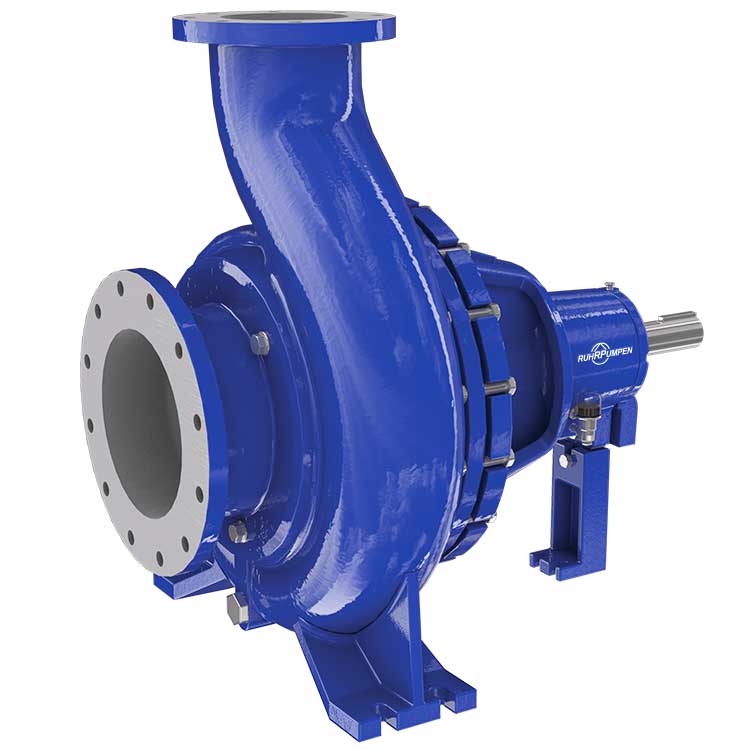
Efficient hydraulics with simple maintenance
The Ebara GS is a single-stage end suction centrifugal pump designed around the EN 733 dimensional standard. Its impeller is designed using Ebara's 3D inverse design method, giving higher efficiency than earlier models. Higher efficiency means a smaller motor can often do the same job, cutting power use and making the unit more compact.
The GS covers capacities up to 1,300 m³/h at 50 Hz and 1,500 m³/h at 60 Hz, with heads up to 150 m, liquid temperatures from -10 °C to 140 °C and working pressures up to 25 bar. Casings are cast iron or ductile iron, and impellers are available in cast iron, ductile iron, bronze or stainless steel.
For maintenance teams, the back pull-out construction is the main benefit. The rotating assembly comes out without disturbing suction or discharge piping. Shielded bearings need no oil changes, and the standard build needs no seal flushing, quenching or air bleeding. For plants running pumps around the clock, these details add up to fewer planned stoppages and lower lifetime maintenance cost.
- Capacities to 1,300 m³/h (50 Hz) and 1,500 m³/h (60 Hz)
- Heads up to 150 m; pressures up to 25 bar
- Impeller designed with 3D inverse design technology
- Back pull-out for service without disturbing pipework
- Shielded bearings with no oil top-up needed
- EN 733 dimensions, EN 12756 seal, EN 294 guard
GS technical specifications
| Capacity | Up to 1,300 m³/h (50 Hz); up to 1,500 m³/h (60 Hz) |
|---|---|
| Head | Up to 150 m (50 Hz and 60 Hz) |
| Liquid temperature | -10 °C to 140 °C |
| Max. working pressure | Up to 25 bar (2.5 MPa) |
| Casing material | Cast iron, ductile cast iron |
| Impeller material | Cast iron, ductile cast iron, bronze, stainless steel |
| Pump standard | EN 733 |
| Mechanical seal | To EN 12756 |
| Coupling guard | Fitted in accordance with EN 294 |
| Bearings | Shielded, no oil replenishment required |
| Rotation | Clockwise viewed from coupling end |
Ebara products are supplied by Pumping Solutions; we are not the manufacturer.
What makes the GS easy to own
Lower energy use
Efficient 3D-designed hydraulics reduce absorbed power, which can allow a smaller motor and lower running cost over the pump's working life.
Back pull-out service
Remove the motor, bearing frame and impeller as one unit while the casing and pipework stay in place, shortening inspection and repair time.
Minimal upkeep
Shielded bearings need no lubricant changes, and the standard build needs no seal flushing, quenching piping or air bleeding.
Standard dimensions
EN 733 pump dimensions and EN 12756 mechanical seals make replacement, interchange with existing pumps and spares sourcing more straightforward for maintenance teams.
Where the GS is used
Ebara GS Series — FAQs
Straight answers to the questions buyers ask us most. Can't find yours? Ask an engineer directly.
What does back pull-out mean on the GS pump?
Back pull-out means the bearing frame, shaft, seal and impeller can be withdrawn from the back of the casing while the casing stays bolted to the suction and discharge pipes. Maintenance teams can inspect or replace parts without breaking pipe joints or realigning pipework, which typically shortens downtime considerably compared with pumps that must be fully removed.
Which impeller material should I choose?
Cast iron or ductile iron suits clean water and general service. Bronze is often chosen for better corrosion resistance in cooling water and mildly corrosive water. Stainless steel is preferred for aggressive water, higher hygiene needs or longer life in demanding conditions. Tell us the liquid, its temperature and any chemical dosing and we will recommend a suitable combination.
What details are needed to size a GS pump?
We need the design flow, total head, liquid and temperature, available suction head (NPSH available or suction conditions), power supply frequency and any preferred motor or material. If you are replacing an existing pump, its nameplate data and pipe sizes help us match the duty and the EN 733 footprint.
How does the GS save energy?
Its impeller is designed with 3D inverse design technology, improving hydraulic efficiency over earlier models. A more efficient pump draws less power for the same duty and can often run with a smaller motor. Correct sizing matters just as much: a pump selected close to its best efficiency point typically uses noticeably less energy than an oversized one.
Related pump models
Get the right GS end suction pump sized for your duty
Share your flow, head and liquid details and we will recommend the GS size, materials and motor that suit your application.